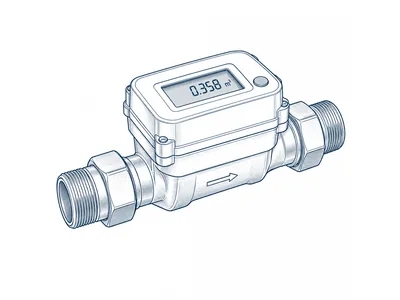
Advantages: no measuring rotor, electronic diagnostics in many models, and products suited to remote consumption monitoring. Some have wide certified measuring ranges.
Limitations: bubbles, deposits and poor acoustic conditions can affect measurement. Electronics still require power. A long battery-life claim depends on the actual measuring, logging and communications configuration.
Before buying: compare the certified flow range, number of acoustic paths, approved orientation, air/empty-pipe behavior, battery conditions and supported outputs. “No moving parts” does not mean no inspection or eventual replacement.
Transit-time and Doppler ultrasonic methods are different; their fluid requirements should not be confused. Kamstrup ultrasonic and electromagnetic comparison
What to specify for this type
- Fluid acoustic conditions and bubbles
- Approved Q values and orientation
- Battery-life assumptions and power for outputs
- Forward/reverse total treatment and data availability
Flow range and communications
Match actual minimum, normal, continuous maximum and peak flow to the exact configuration. A shared pipe size does not establish equivalent performance.
A connected metering system is five parts: meter → interface or module → network or gateway → software → billing, dashboard or control system. A quotation should name who supplies and maintains each one. AMR-ready equipment may still require separately quoted radio, gateway, head-end and billing software.
Read the detailed measuring-principle guide · Understand sizing and accuracy · Compare communication options